Home Blogs Product Information Types, Characteristics, and Applications of Advanced Structural Ceramics
Types, Characteristics, and Applications of Advanced Structural Ceramics
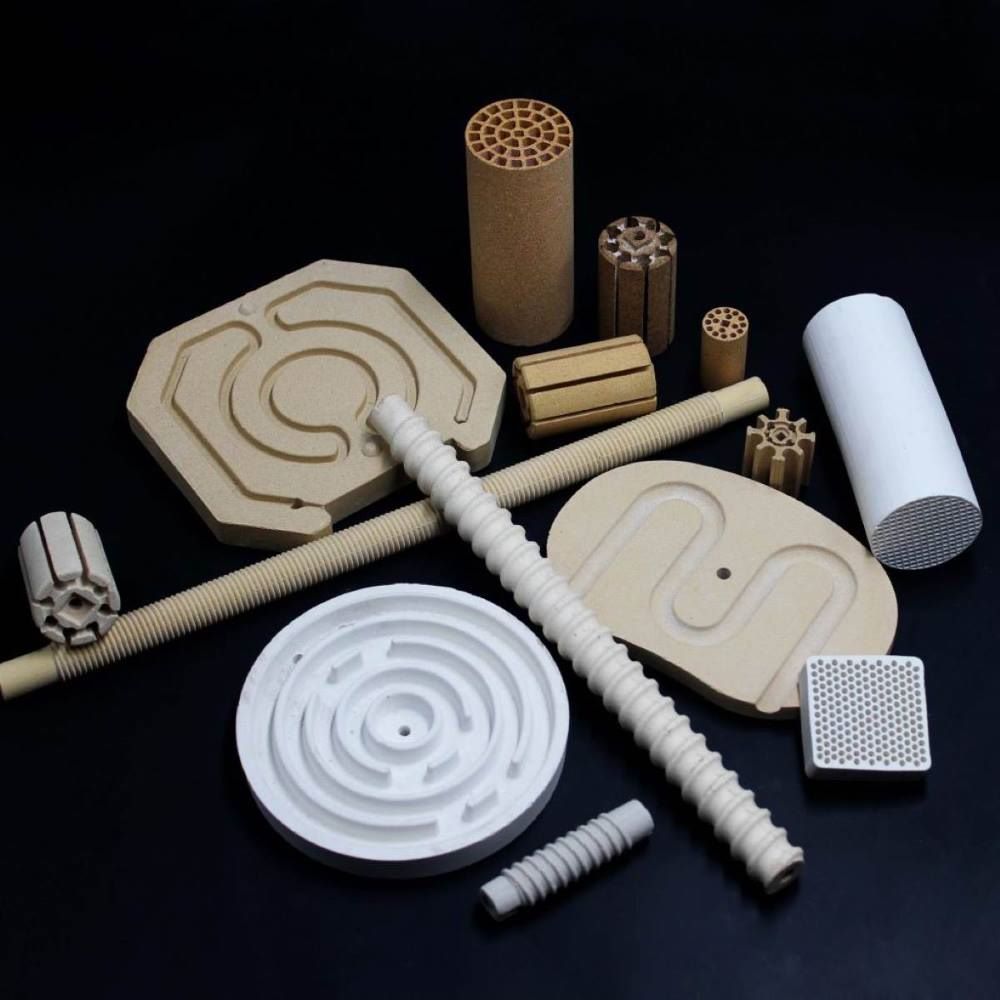
Structural ceramics represent a specialized class of inorganic nonmetallic materials engineered to deliver exceptional mechanical performance under extreme operational conditions. Characterized by their unique combination of high hardness, thermal stability, wear resistance, and chemical inertness, these materials have emerged as critical enablers for advanced technologies in aerospace, energy, and precision manufacturing sectors.
This article provides a systematic analysis of major structural ceramic types, their intrinsic properties, and evolving industrial applications.
This article provides a systematic analysis of major structural ceramic types, their intrinsic properties, and evolving industrial applications.
Core Characteristics of Structural Ceramics
Structural ceramics distinguish themselves from conventional ceramics through optimized microstructural engineering.
Key attributes include:
Structural ceramics distinguish themselves from conventional ceramics through optimized microstructural engineering.
Key attributes include:
- Mechanical robustness: Vickers hardness values typically exceeding 15 GPa and flexural strengths up to 1 GPa
- Thermal resilience: Operational capabilities in excess of 1,400°C without structural degradation
- Chemical durability: Resistance to oxidation, acid/alkali corrosion, and molten metal erosion
- Tribological superiority: Wear rates up to three orders of magnitude lower than alloy counterparts
These properties derive from strong covalent/ionic bonding and carefully engineered microstructures featuring submicron grain sizes and controlled secondary phases.
Major Structural Ceramic Systems
As the most mature structural ceramic system, alumina demonstrates:
- 99.5% purity grades with hardness of 20-22 GPa (HV)
- Thermal stability up to 1,600°C in oxidizing atmospheres
- Dielectric strength >15 kV/mm
Applications extend beyond traditional refractory linings to:
- HIP-processed transparent armor windows (85% transmittance in visible spectrum)
- Medical implant coatings with controlled surface porosity (30-50 μm)
- Plasma-resistant components in semiconductor etching chambers
Current research focuses on achieving full density sintering below 1,400°C through liquid-phase additives like SiO₂-CaO-MgO systems.
2. Zirconia (ZrO₂) Ceramics
Yttria-stabilized tetragonal zirconia polycrystals (Y-TZP) exhibit:
Yttria-stabilized tetragonal zirconia polycrystals (Y-TZP) exhibit:
- Unmatched fracture toughness (8-10 MPa·m¹/²) via phase transformation toughening
- Flexural strength exceeding 1.2 GPa
- Low thermal conductivity (2-3 W/m·K)
Advanced applications include:
- Dental prosthetics with biomimetic modulus (200 GPa)
- High-load ceramic bearings for aerospace actuators
- MEMS substrates with near-zero thermal expansion
Recent developments incorporate CeO₂ or TiO₂ dopants to enhance hydrothermal stability against low-temperature degradation.
3. Silicon Nitride (Si₃N₄) Ceramics
Gas-pressure sintered Si₃N₆ demonstrates:
Gas-pressure sintered Si₃N₆ demonstrates:
- Retained strength >800 MPa at 1,200°C
- Thermal shock resistance (ΔT >800°C)
- Fatigue resistance under cyclic loading (10⁷ cycles at 600 MPa)
Strategic implementations feature:
- Turbine blades for 1,500°C-class jet engines
- Hybrid ceramic roller bearings for all-electric vehicles
- Semiconductor wafer handling robots
Ongoing research optimizes β-Si₃N₄ grain aspect ratios (6:1 to 10:1) through seeding techniques to maximize fracture energy.
4. Silicon Carbide (SiC) Ceramics
Liquid-phase sintered SiC offers:
Liquid-phase sintered SiC offers:
- Thermal conductivity up to 120 W/m·K
- Oxidation resistance to 1,650°C in air
- Radiation hardness (10⁸ Gy tolerance)
Critical applications encompass:
- Nuclear fuel cladding with He leak rates <10⁻⁹ mbar·l/s
- Wafer processing susceptors for GaN epitaxy
- Mirror substrates for EUV lithography systems
Current innovations focus on developing fiber-reinforced SiC composites (CVI-processed) for hypersonic vehicle thermal protection.
Emerging Trends and Challenges
While structural ceramics adoption grows at 6.8% CAGR (2023-2030), key challenges persist:
While structural ceramics adoption grows at 6.8% CAGR (2023-2030), key challenges persist:
- Cost-effective manufacturing of complex geometries
- Joining technologies for ceramic-metal hybrid systems
- Standardization of non-destructive evaluation methods
Promising developments include:
- Additive manufacturing of gradient-architecture components
- Self-healing ceramics incorporating MAX phase additives
- AI-driven microstructure optimization algorithms
Conclusion
Structural ceramics continue to redefine performance boundaries in extreme environment engineering. With global market projections exceeding $12.6 billion by 2030, ongoing advancements in nanoscale engineering and hybrid material systems promise to unlock new frontiers in power generation, space exploration, and advanced manufacturing. The successful transition from laboratory innovation to industrial implementation will require coordinated efforts in fundamental materials science, precision manufacturing technologies, and cross-disciplinary system integration.
Structural ceramics continue to redefine performance boundaries in extreme environment engineering. With global market projections exceeding $12.6 billion by 2030, ongoing advancements in nanoscale engineering and hybrid material systems promise to unlock new frontiers in power generation, space exploration, and advanced manufacturing. The successful transition from laboratory innovation to industrial implementation will require coordinated efforts in fundamental materials science, precision manufacturing technologies, and cross-disciplinary system integration.
Website:www.beteceramics.cn
Email:info@beteceramics.cn
WhatsApp:+8619067928639
Release time: 2025-03-08
Types and Characteristics of Alumina Ceramics
Heat-Resistant Steatite Threaded Ceramic Parts